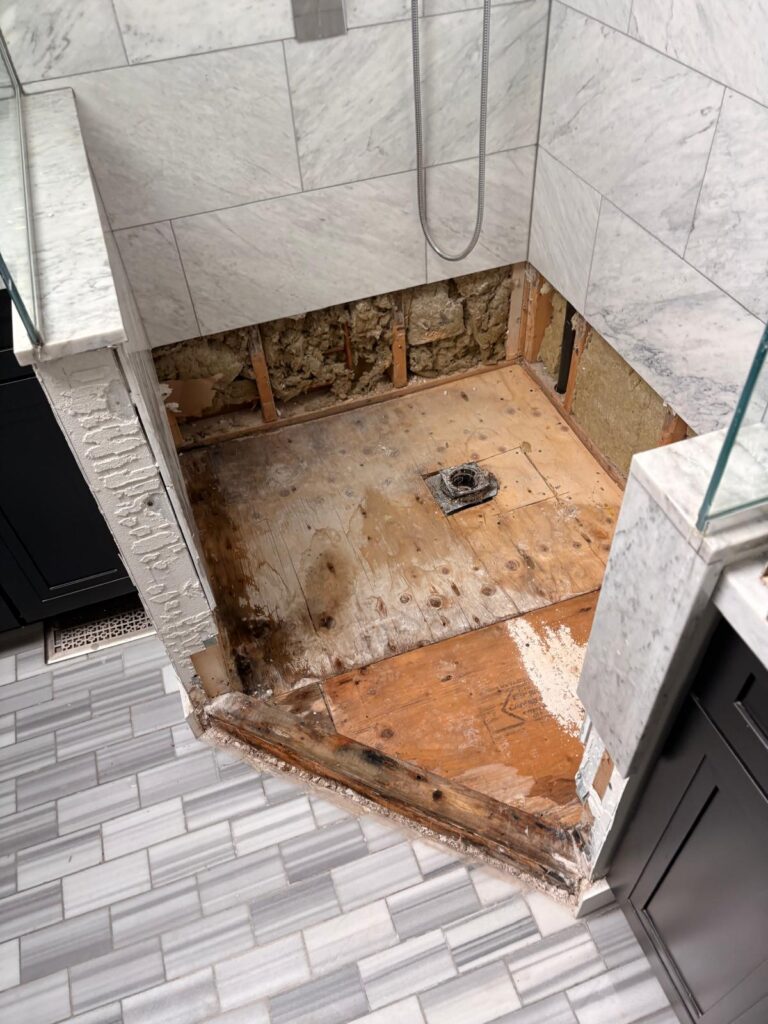
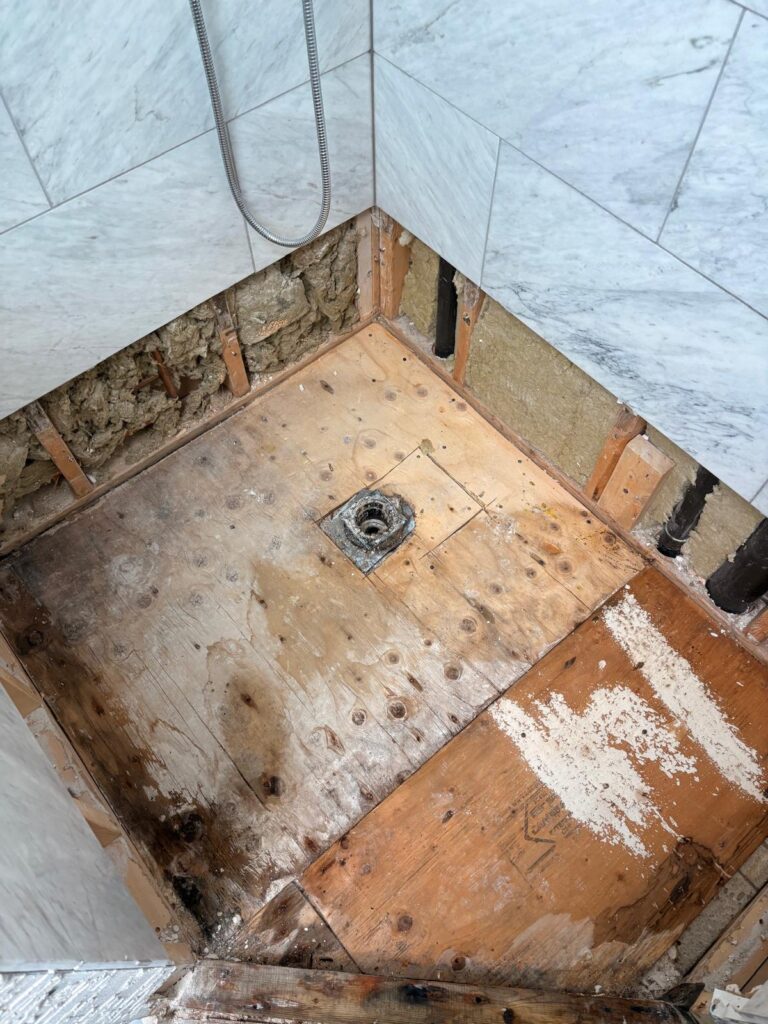
We pulled tile off a Toronto shower not long ago and found green board soaked through, black mould running a metre up the wall, and a subfloor that had started to soften. The homeowner had been using it for three years without knowing. The outside looked fine. Someone had even done a fresh regrout recently.
The fix was not a tile job. It was a full demo to the studs, new framing, new subfloor, then a complete rebuild. That is what happens when someone puts tile over a substrate that is not actually waterproof and calls it done.
This guide covers what we use instead and why. If you are planning a bathroom renovation in the GTA, this is the most important section you will read.
Why Green Board and Cement Board Are Not Waterproofing
Green board is moisture-resistant drywall. Cement board is a stable tile substrate. Neither is a waterproofing membrane, and neither was designed to be. They resist incidental moisture. They do not stop sustained water exposure.
A shower puts more water onto a surface in a single year than your roof does, according to Schluter’s own product research. Water gets through grout joints every time someone showers. Grout is porous, and it shrinks and cracks as a house moves. Once water is past the grout, it sits against whatever is behind the tile. In this climate, the combination of cold exterior walls, heated indoor air, and freeze-thaw cycles from November through March accelerates that process significantly.
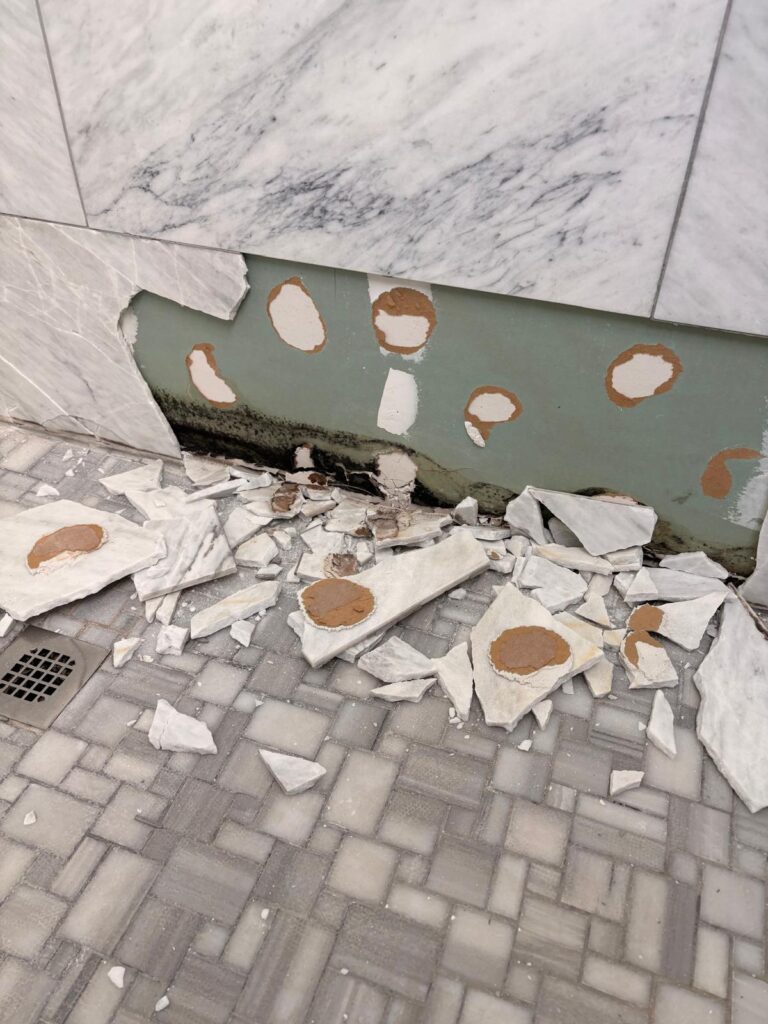
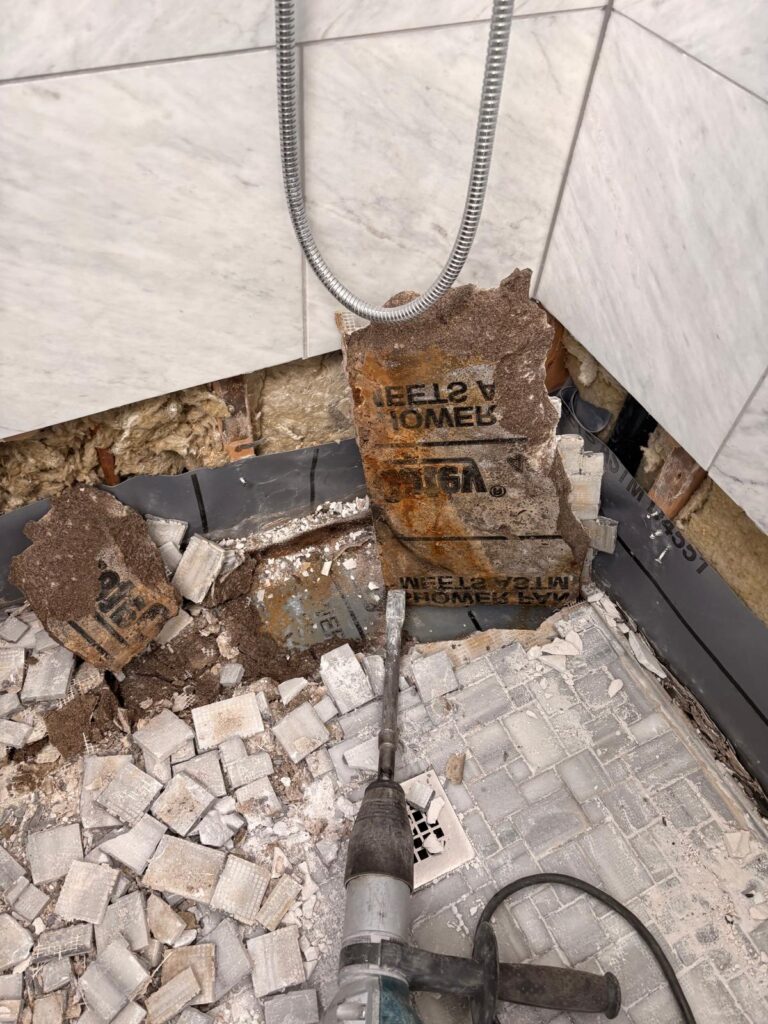
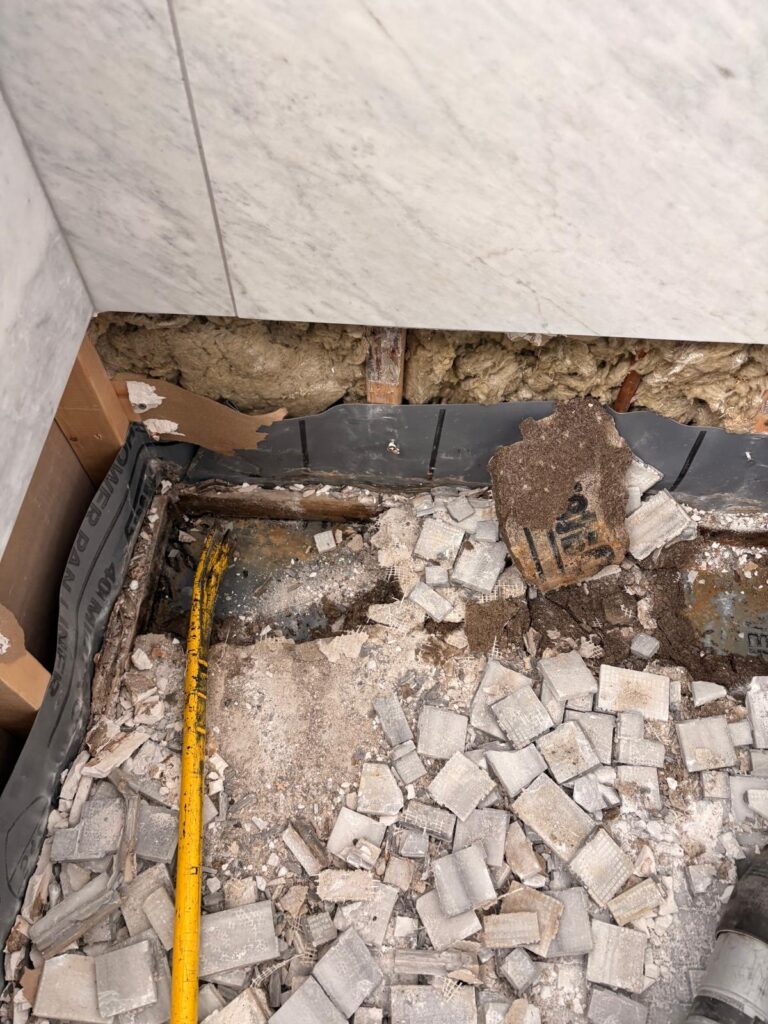
WHAT CONTRACTORS FIND WHEN THEY OPEN FAILED LOCAL SHOWERS
- No waterproofing membrane behind walls or on the floor
- Green board used as the tile substrate in the wet zone
- KERDI installed with modified thin-set — wrong mortar, never properly bonded
- Missing KERDI-BAND at floor-to-wall transitions
- Drain not integrated with the waterproofing layer
What the Schluter System Actually Is
Schluter-Systems has been making tile installation products in Germany since 1966. Their waterproofing line is a family of components designed to work together as one sealed assembly, not a single product.
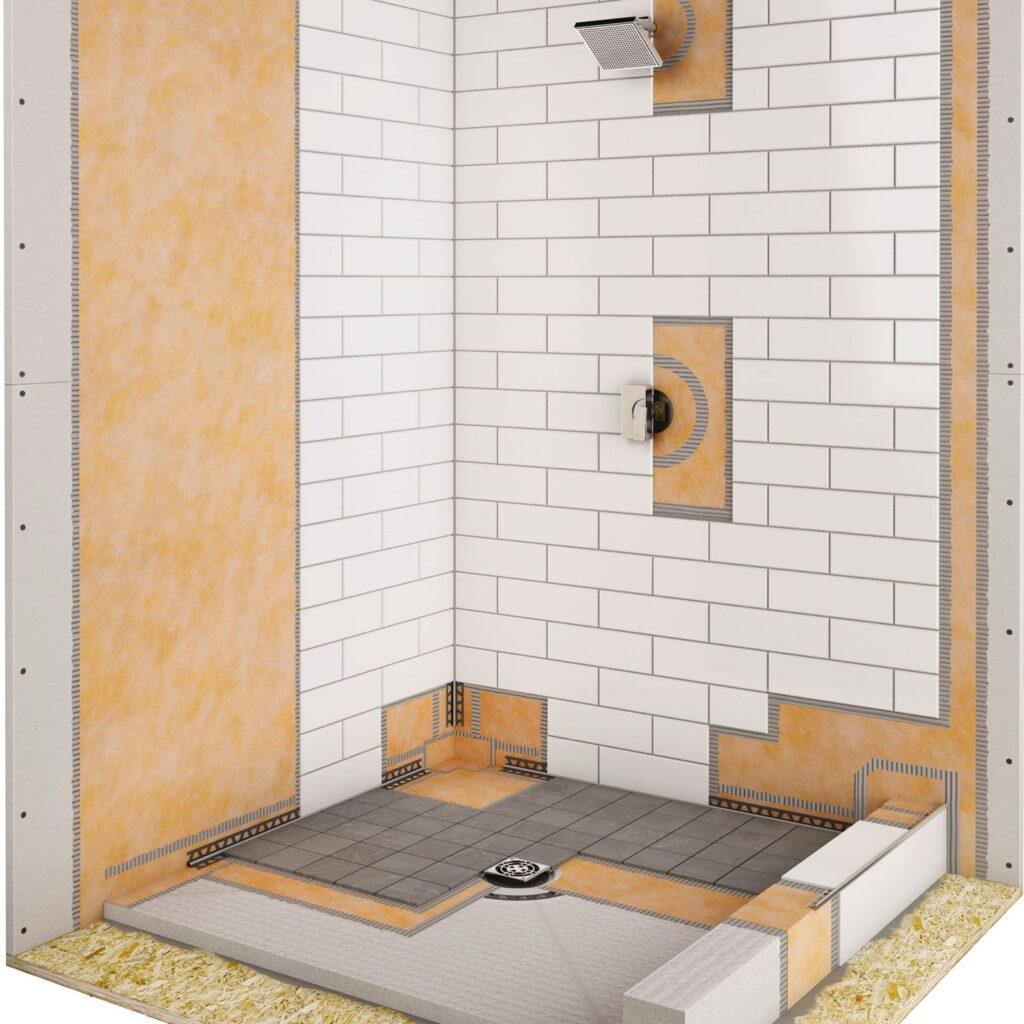
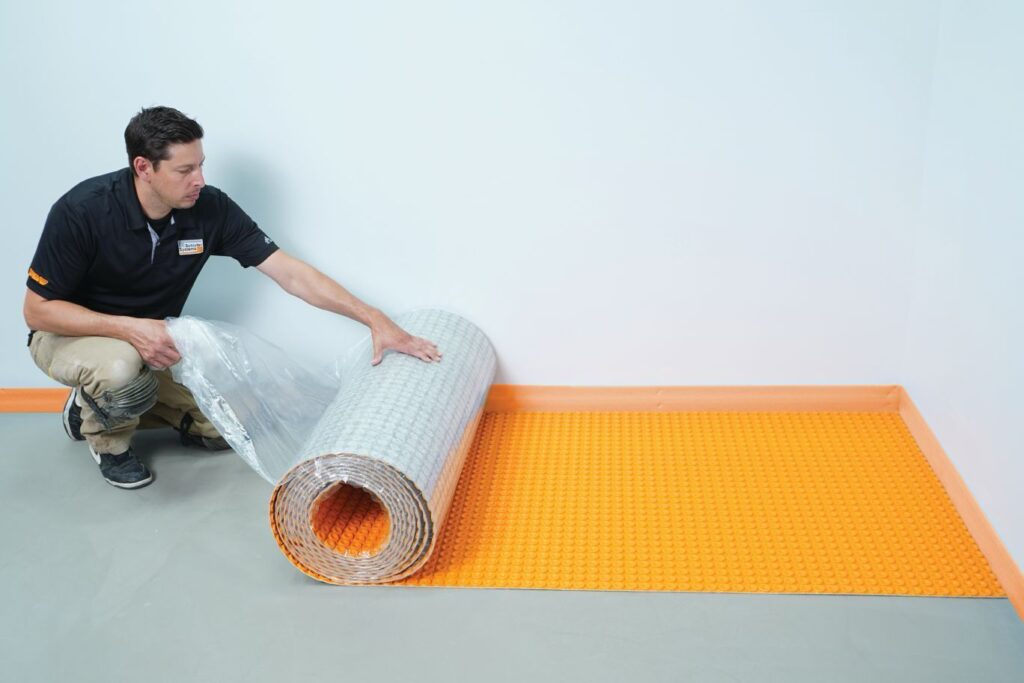
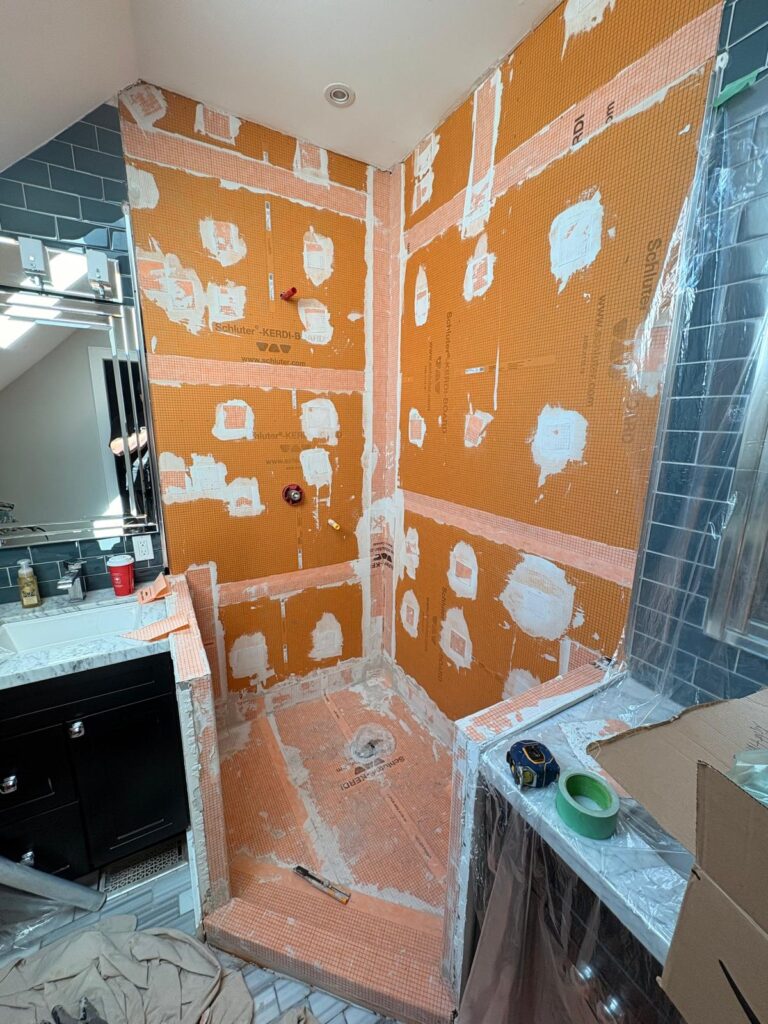
KERDI Membrane is the core. It is an 8-mil polyethylene sheet with polypropylene fleece bonded to both faces. You press it into unmodified thin-set and the mortar squeezes through the fleece on both sides, fully bonding the membrane to the substrate below and letting tile bond to the face above. Because it is sheet-applied, the thickness is uniform everywhere. No thin spots from uneven brush strokes, no gaps where a roller ran dry in a corner.
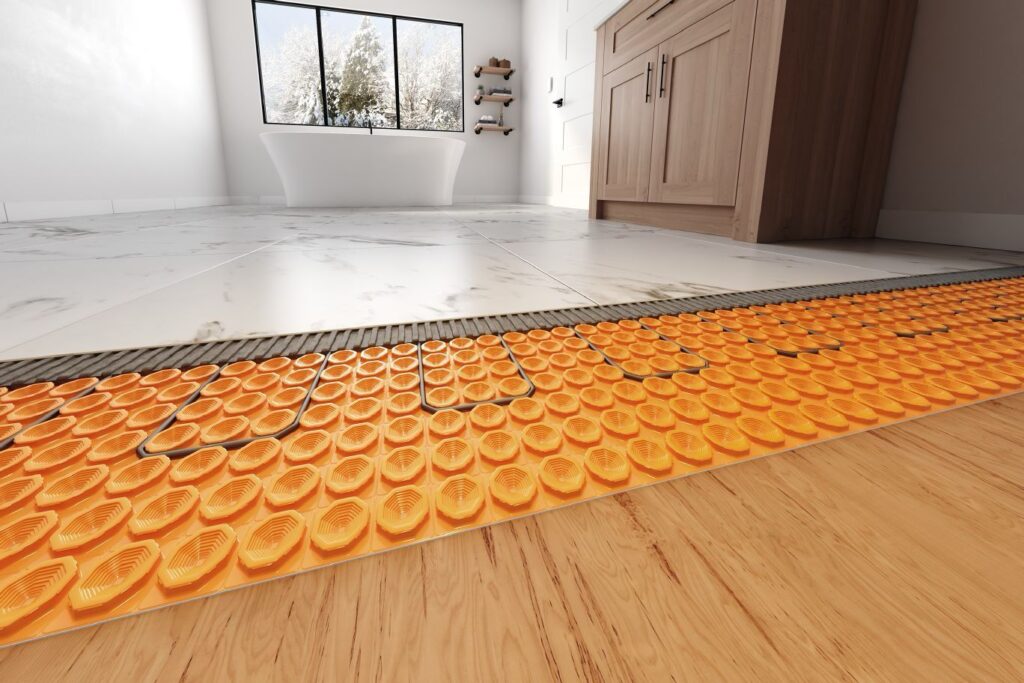
DITRA Uncoupling Mat goes on floors. Its waffle-grid cavity structure allows the tile layer to move slightly independently from the substrate below. This matters in older Ontario homes specifically because seasonal subfloor movement in houses built before about 1985 is common and direct-bond tile installations crack over time. DITRA is also about 5mm thick and very light, which matters for condo floor assemblies that have weight restrictions.
KERDI-BOARD is a rigid foam panel with KERDI laminated to both faces. It replaces cement board on shower walls and is the right substrate for custom niches, benches, and curbs. Lighter than cement board, already waterproof, and tile goes straight onto it with thin-set.
KERDI-DRAIN is where a lot of local bathroom installations quietly fail. If the drain is not bonded to the waterproofing membrane, there is a gap at the exact point where all the water goes. The KERDI-DRAIN has an integrated bonding flange that the membrane adheres to directly in thin-set, sealing that connection completely.
KERDI-BAND seals every seam, butt joint, and transition. Every inside corner gets KERDI-BAND or a preformed KERDI-KERECK corner piece. Every pipe gets a KERDI-SEAL collar. These are the details that separate a waterproofed shower from one that just looks waterproofed.
How It Compares to Other Systems Used in the GTA
Schluter is not the only legitimate waterproofing system. Laticrete HydroBan and RedGard are both used by experienced GTA contractors. Here is how they compare.
| SYSTEM | TYPE | UNIFORM THICKNESS? | HANDLES FLOOR MOVEMENT? |
| Schluter KERDI + DITRA | Sheet-applied | Yes, 8 mil consistent | Yes (DITRA uncoupling) |
| RedGard | Brush/roll liquid | Depends on applicator | Limited |
| Laticrete HydroBan | Liquid-applied | Depends on applicator | Better than RedGard |
| Green/cement board | Substrate only | No | No |
The reason experienced local contractors settle on Schluter is the consistency argument. A sheet-applied membrane gives the same performance everywhere on the surface. Liquid membranes depend on how evenly they are applied. Thin spots at corners and transitions are where failures originate years later, and they are invisible once tile is installed.
| “I’ve trusted and used Schluter products for decades because they work. Schluter consistently designs and manufactures new products that work together, always providing a solution.” MIKE HOLMES | MAKEITRIGHT.CA |
What a Proper Installation Looks Like
Understanding the installation sequence is how you evaluate whether a contractor is doing the job or just using Schluter brand products incorrectly.
- Substrate prep. The substrate must be flat and solidly attached. In houses built before the 1980s, this sometimes means adding a second layer of plywood. If the floor flexes, the membrane will eventually delaminate at the wall-to-floor joint.
- KERDI in unmodified thin-set. The KERDI is pressed into thin-set and worked until mortar squeezes through the fleece on both sides. Modified mortar should not be used. It contains polymers that dry rather than cure, and in a bonded assembly those polymers compromise the long-term adhesion. This is the single most common error we see on failed shower jobs in the area.
- Sealing every corner and penetration. Every inside corner gets KERDI-BAND or a preformed corner piece. Every pipe gets a KERDI-SEAL collar. Every seam overlaps 5 cm minimum. Skipping any of these creates a gap that is invisible once tile is installed.
- Flood testing before tile. Plug the drain, fill the pan to the top of the curb, wait 24 hours. Any drop in water level tells you where the leak is before tile covers it permanently. Schluter’s own installation handbook specifies this test. Walk away from any contractor who says it is not necessary.
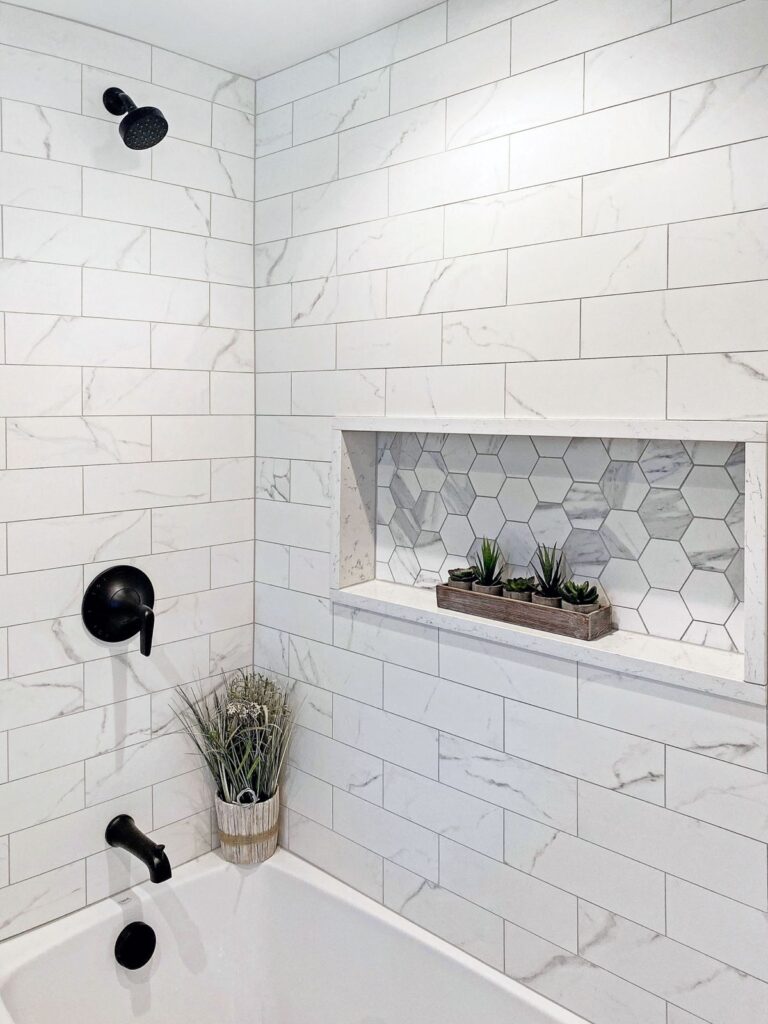
Planning a bathroom renovation in Toronto?
We use Schluter on every project and flood test every shower before tile goes in.
Book a free consultation: Contact Us
Why This Region Specifically
Old housing stock
A large share of homes in the Toronto area were built between the 1940s and 1970s. Wood subfloors that flex seasonally, framing that has absorbed decades of moisture, and original plumbing not designed for modern water volumes. DITRA on the floor is not optional in a pre-1980s home. It is what keeps tile from cracking within five years.
Condo density
In a downtown condo, a leaking shower floor travels to the ceiling of the unit below. That means insurance claims, strata disputes, and shared repair costs. Building management in these buildings also increasingly requires documented waterproofing methods in renovation approval packages. DITRA’s low weight profile helps with slab load restrictions too.
What It Costs in 2026
Total addition to a standard Schluter upgrade in the Toronto area starts upgrade starts $1,500 and goes up to $3,000.
KERDI membrane runs $4 to $7 per square foot at Canadian tile suppliers. DITRA is $3 to $5 per square foot. A KERDI-DRAIN is $80 to $200. Labour in the GTA runs $65 to $120 per hour and a proper Schluter installation adds 5 to 8 hours to a shower project.
Total addition to a standard shower renovation in the Toronto area: roughly $400 to $1,200.
Compare that to water damage remediation costs in this market, which renovation guides from 2025 and 2026 consistently put at $10,000 to $30,000 depending on how far the moisture travelled and whether a unit below was affected. The waterproofing cost is not an upgrade. It is protection for everything else.
Three Questions to Ask Any Contractor Before They Start
What mortar do you use to bond the KERDI membrane?
The correct answer is unmodified thin-set. If they say modified or latex-modified, they are using the wrong product. This is the most common installation error we see on failed jobs.
Do you flood test the shower before tiling?
If the answer is no, ask why. There is no good reason to skip it. If they say they check visually, that is not a flood test.
Can I see photos of the waterproofing before tile went on?
Any contractor who installs Schluter correctly should have these. Finished tile photos tell you nothing about what went behind them.
Standards and Code in Ontario
The Ontario Building Code requires a waterproof membrane in wet areas but does not specify which product. That means a contractor can claim code compliance while using a method experienced renovators consider inadequate. Schluter KERDI meets ANSI A118.10 and A118.12, and is recognized by the Terrazzo Tile and Marble Association of Canada (TTMAC).
External: ttmac.com
External: ontario.ca/laws (Ontario Building Code reference)
Frequently Asked Questions
What is the Schluter waterproofing system?
A family of products including KERDI membrane, DITRA uncoupling mat, KERDI-BOARD panels, KERDI-DRAIN, and KERDI-BAND that together create a fully bonded, watertight assembly behind tile. Instead of relying on tile and grout to keep water out, you put a dedicated waterproof barrier between the tile and the substrate behind it.
What mortar should be used with Schluter KERDI?
Unmodified thin-set mortar. Modified mortars contain polymers that dry rather than cure and can compromise the bond in a fully bonded assembly. Using modified mortar is the most common installation error we see on failed shower jobs.
Does a Schluter installation need a flood test?
Yes. Plug the drain, fill the pan to the top of the curb, wait 24 hours. Any drop in water level tells you where the leak is before tile covers it permanently. Schluter’s installation handbook specifies this test.
How much does Schluter waterproofing add to a Toronto-area bathroom renovation?
Based on current GTA pricing, roughly $400 to $1,200 depending on scope. KERDI is $4 to $7 per square foot, DITRA is $3 to $5, a KERDI-DRAIN is $80 to $200, and labour adds 5 to 8 hours at $65 to $120 per hour. One water damage remediation event in this market costs $10,000 to $30,000. The waterproofing cost is protection, not an upgrade.
The Bottom Line
This is not a forgiving climate for bathrooms that were not waterproofed properly. Old housing stock, condo density, freeze-thaw cycles, and below-grade basements all mean that what goes behind the tile matters more here than in most places. The Schluter system became the standard among serious local contractors because it solves the actual failure modes: uniform thickness, bonded installation, integrated drain, and a flood test before anything gets covered up.
If you are planning a bathroom renovation in Toronto and want to know what we would actually do and why, get in touch. We are happy to walk through it at no charge.
| Ready to start? Licensed Toronto renovation contractors. Schluter waterproofing on every shower. Call 647-806-5802. Get a free quote: Contact Us |